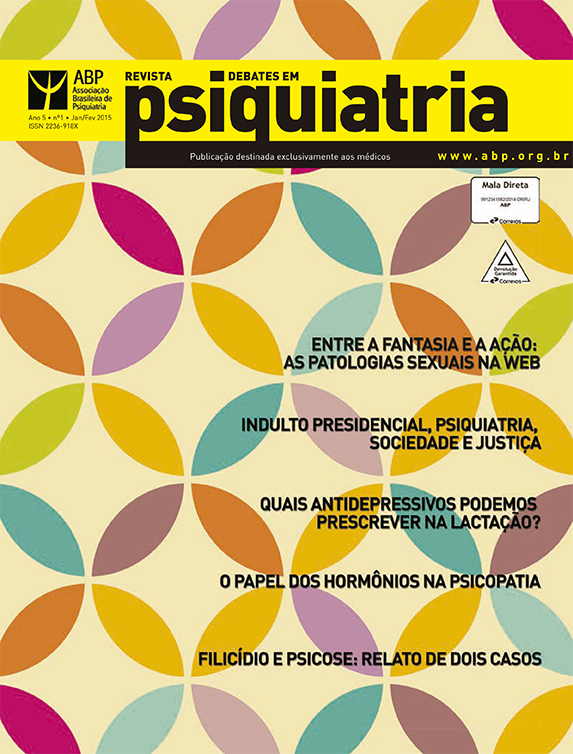
Filicide and psychosis: report of two cases
DOI:
https://doi.org/10.25118/2236-918X-5-1-6Keywords:
Filicide, psychosis, mental healthAbstract
Individuals have a four-fold higher chance of being a victim of murder in the first year of life. This article presents definitions of filicide and reports on two cases of women with psychotic disorders who tried to murder their children. The role of mental health services in preventing the loss of contact and non-adherence to treatment is emphasized, as these aspects frequently precede homicide committed by people with severe mental illnesses.
Downloads
Metrics
References
Marks MN, Kumar R. Infanticide in England and Wales. Med Sci Law. 1993;33:329-39.
Flynn SM, Shaw JJ, Abel KM. Homicide of infants: a cross-sectional study. J Clin Psychiatry. 2007;68:1501-9.
Krischer MK, Stone MH, Sevecke K, Steinmeyer EM. Motives for maternal fi licide: results from a study with female forensic patients. Int J Law Psychiatry. 2007;30:191-200.
Resnick PJ. Child murder by parents: a psychiatric review of fi licide. Am J Psychiatry. 1969;126:325-34.
Bourget D, Labelle A. Homicide, infanticide, and fi licide. Psychiatr Clin North Am. 1992;15:661-73.
Downloads
Published
How to Cite
Issue
Section
License

This work is licensed under a Creative Commons Attribution-NonCommercial 4.0 International License.
Debates em Psiquiatria allows the author (s) to keep their copyrights unrestricted. Allows the author (s) to retain their publication rights without restriction. Authors should ensure that the article is an original work without fabrication, fraud or plagiarism; does not infringe any copyright or right of ownership of any third party. Authors should also ensure that each one complies with the authorship requirements as recommended by the ICMJE and understand that if the article or part of it is flawed or fraudulent, each author shares responsibility.
Attribution-NonCommercial 4.0 International (CC BY-NC 4.0) - Debates em Psiquiatria is governed by the licencse CC-By-NC
You are free to:
- Share — copy and redistribute the material in any medium or format
- Adapt — remix, transform, and build upon the material
The licensor cannot revoke these freedoms as long as you follow the license terms. Under the following terms:
- Attribution — You must give appropriate credit, provide a link to the license, and indicate if changes were made. You may do so in any reasonable manner, but not in any way that suggests the licensor endorses you or your use.
- NonCommercial — You may not use the material for commercial purposes.
No additional restrictions — You may not apply legal terms or technological measures that legally restrict others from doing anything the license permits.