
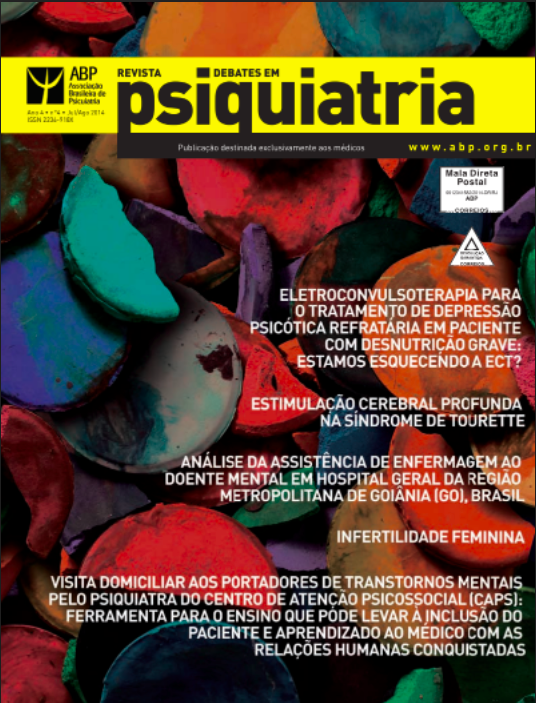
Electroconvulsive therapy for the treatment of refractory psychotic depression in a patient with severe malnutrition: are we forgetting ECT?
DOI:
https://doi.org/10.25118/2236-918X-4-4-1Keywords:
Electroconvulsive therapy, severe depression, psychotic symptoms, malnutritionAbstract
Depressive disorders are an important public health problem. This article describes the case a 35-year old female patient admitted due to severe depression with psychotic symptoms and refractory to pharmacological treatment. Over 3 years of psychiatric therapy, electroconvulsive therapy (ECT) had never been offered as a treatment option. The patient was treated with ECT and showed significant improvement of psychiatric and physical symptoms, and currently leads a normal life. The indications and limitations of ECT are discussed.
Downloads
Metrics
References
Viana MC, Andrade LH. Lifetime prevalence, age and gender distribution and age-of-onset of psychiatric disorders in the São Paulo Metropolitan Area, Brazil: results from the São Paulo Megacity Mental Health Survey. Rev Bras Psiquiatr. 2012;34:249-60. https://doi.org/10.1016/j.rbp.2012.03.001
Whiteford HA, Degenhardt L, Rehm J, Baxter AJ, Ferrari AJ, Erskine HE, et al. Global burden of disease attributable to mental and substance use disorders: fi ndings from the Global Burden of Disease Study 2010. Lancet. 2013;382:1575-86. https://doi.org/10.1016/S0140-6736(13)61611-6
Berlim MT, Turecki G. Defi nition, assessment, and staging of treatment-resistant refractory major depression: a review of current concepts and methods. Can J Psychiatry. 2007;52:46-54. https://doi.org/10.1177/070674370705200108
McIntyre RS, Filteau MJ, Martin L, Patry S, Carvalho A, Cha DS, et al. Treatment-resistant depression: definitions, review of the evidence, and algorithmic approach. J Affect Disord. 2014;156:1-7. https://doi.org/10.1016/j.jad.2013.10.043
Kessler RC, McGonagle KA, Zhao S, Nelson CB, Hughes M, Eshleman S, et al. Lifetime and 12-month prevalence of DSMIII-R psychiatric disorders in the United States. Results from the National Comorbidity Survey. Arch Gen Psychiatry. 1994;51:8-19. https://doi.org/10.1001/archpsyc.1994.03950010008002
Kessler RC, Berglund P, Demler O, Jin R, Koretz D, Merikangas KR, et al. The epidemiology of major depressive disorder: results from the National Comorbidity Survey Replication (NCS-R). JAMA. 2003;289:3095-105. https://doi.org/10.1001/jama.289.23.3095
Dentino AN, Pieper CF, Rao MK, Currie MS, Harris T, Blazer DG, et al. Association of interleukin-6 and other biologic variables with depression in older people living in the community. J Am Geriatr Soc. 1999;47:6-11. https://doi.org/10.1111/j.1532-5415.1999.tb01894.x
Sienaert P, Vansteelandt K, Demyttenaere K, Peuskens J.Randomized comparison of ultra-brief bifrontal and unilateral electroconvulsive therapy for major depression: cognitive sideeffects. J Affect Disord. 2010;122:60-7. https://doi.org/10.1016/j.jad.2009.06.011
Alves M, Abreu PM. Eletroconvulsoterapia: eficácia, efeitos adversos, medidas de segurança, mecanismo de ação e complicações. Debates em Psiquiatria. 2012;2:14-20.
Berlim MT, Van den Eynde F, Daskalakis ZJ. Effi cacy and acceptability of high frequency repetitive transcranial magnetic stimulation (rTMS) versus electroconvulsive therapy (ECT) for major depression: a systematic review and meta-analysis of randomized trials. Depress Anxiety. 2013;30:614-23. https://doi.org/10.1002/da.22060
Tess AV, Smetana GW. Medical evaluation of patients undergoing electroconvulsive therapy. N Engl J Med. 2009;360:1437-44. https://doi.org/10.1056/NEJMra0707755
Semkovska M, McLoughlin DM. Objective cognitive performance associated with electroconvulsive therapy for depression: a systematic review and meta-analysis. Biol Psychiatry. 2010;68:568-77. https://doi.org/10.1016/j.biopsych.2010.06.009
Ribeiro RB, Melzer-Ribeiro DL, Rigonatti SP, Cordeiro Q. Electroconvulsive therapy in Brazil after the "psychiatric reform": a public health problem--example from a university service. J ECT. 2012;28:170-3. https://doi.org/10.1097/YCT.0b013e31824d2889
Ribeiro RB, Melzer-Ribeiro DL, Rigonatti SP, Cordeiro Q. Availability and public policies for electroconvulsive therapy in Brazil. J ECT. 2013;29:e69. https://doi.org/10.1097/YCT.0b013e31829239c0
Ribeiro RB, Melzer-Ribeiro DL, Cordeiro Q. Morbidity and mortality due to mental disorders in Brazil. Rev Bras Psiquiatr. 2012;34:217-8. https://doi.org/10.1590/S1516-44462012000200016
Shiozawa P, Brunoni A, Zanuto E, Cordeiro Q, Ribeiro RB. ECT de manutenção no tratamento de paciente idosa com depressão grave, refratária e recorrente: relato de caso. Debates em Psiquiatria. 2013;3:46-9.
Downloads
Published
How to Cite
Issue
Section
License
Copyright (c) 2014 Pedro Shiozawa, Geraldo Teles Machado Netto , Quirino Cordeiro, Rafael Bernardon Ribeiro

This work is licensed under a Creative Commons Attribution-NonCommercial 4.0 International License.
Debates em Psiquiatria allows the author (s) to keep their copyrights unrestricted. Allows the author (s) to retain their publication rights without restriction. Authors should ensure that the article is an original work without fabrication, fraud or plagiarism; does not infringe any copyright or right of ownership of any third party. Authors should also ensure that each one complies with the authorship requirements as recommended by the ICMJE and understand that if the article or part of it is flawed or fraudulent, each author shares responsibility.
Attribution-NonCommercial 4.0 International (CC BY-NC 4.0) - Debates em Psiquiatria is governed by the licencse CC-By-NC
You are free to:
- Share — copy and redistribute the material in any medium or format
- Adapt — remix, transform, and build upon the material
The licensor cannot revoke these freedoms as long as you follow the license terms. Under the following terms:
- Attribution — You must give appropriate credit, provide a link to the license, and indicate if changes were made. You may do so in any reasonable manner, but not in any way that suggests the licensor endorses you or your use.
- NonCommercial — You may not use the material for commercial purposes.
No additional restrictions — You may not apply legal terms or technological measures that legally restrict others from doing anything the license permits.