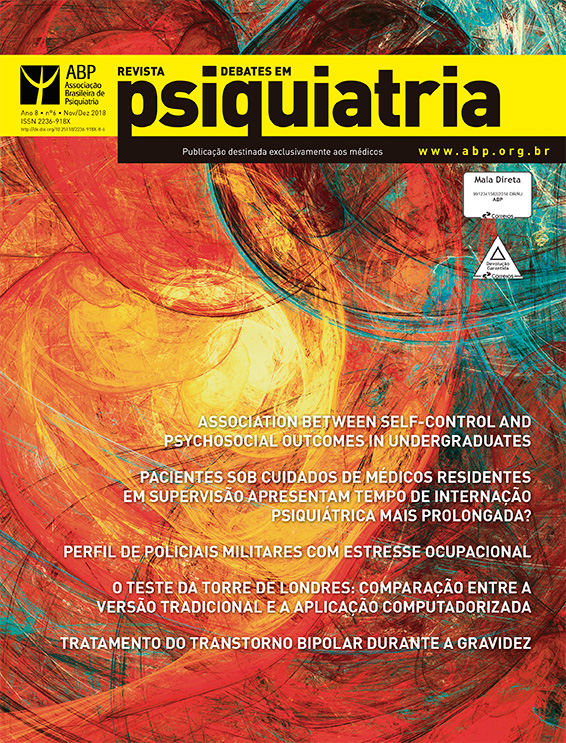
Association between self-control and psychosocial outcomes in undergraduates
DOI:
https://doi.org/10.25118/2763-9037.2018.v8.327Palabras clave:
Self-control, stress, mental health, quality of lifeResumen
Objectives: To analyze how self-regulation processes can impact psychosocial outcomes in university students. Method: We investigated 215 participants. The Barratt Impulsiveness Scale, the Delaying Gratification Inventory, and the Ego Resiliency Scale were used as measures of self control. The psychosocial outcomes analyzed were stress (Cohen’s Perceived Stress Scale), quality of life (World Health Organization Quality of Life instrument-Abbreviated version – WHOQOL-Bref), and mental health (Self-Reporting Questionnaire-20). Results: Self-control measures correlated significantly with all outcomes. In a regression analysis, impulse control and ego resiliency were simultaneously associated with outcomes, while delaying gratification was not significant. Conclusion: Variables of self-regulation were predictors of mental health, stress, and quality of life in university students. These measures may be capable of indicating non-functional outcomes and/or protective factors, depending on how the subject reacts to the environment.
Descargas
Métricas
Citas
Bruff aerts R, Morti er P, Kiekens G, Auerbach RP, Cuijpers P, Demytt enaere K, et al. Mental health problems in college freshmen: prevalence and academic functi oning. J Aff ect Disord. 2018;225:97-103.
Rotenstein LS, Ramos MA, Torre M, Segal JB, Peluso MJ, Guille C, et al. Prevalence of depression, depressive symptoms, and suicidal ideati on among medical students: a systemati c review and metaanalysis. JAMA. 2016;316:2214-36.
Paro HB, Morales NM, Silva CH, Rezende CH, Pinto R, Morales RR, et al. Health-related quality of life of medical students. Med Educ. 2010; 44:227-35.
Andre A, Pierre GC, McAndrew M. Quality of life among dental students: a survey study. J Dent Educ. 2017;81:1164-70.
Fleck MP de A. O instrumento de avaliação de qualidade de vida da Organização Mundial da Saúde (WHOQOL-100): característi cas e perspecti vas. Cienc Saude Coleti va. 2000;5: 33-8.
Goetzel RZ, Long SR, Ozminkowski RJ, Hawkins K, Wang S, Lynch W. Health, absence, disability, and presenteeism cost esti mates of certain physical and mental health conditi ons aff ecti ng U.S. employers. J Occup Environ Med. 2004;46: 398-412.
Pinho TD, Manz PH, DuPaul GJ, Anastopoulos AD, Weyandt LL. Predictors and moderators of quality of life among college students with ADHD. J Atten Disord. 2017 Oct 1:1087054717734645. doi: 10.1177/1087054717734645. [Epub ahead of print]
Uher R, Caspi A, Houts R, Sugden K, Williams B, Poulton R, et al. Serotonin transporter gene moderates childhood maltreatment’s effects on persistent but not single-episode depression: replications and implications for resolving inconsistent results. J Affect Disord. 2011;135: 56-65.
Haase VG, Ferreira FO, Penna FO. Aspectos biopsicossociais da saúde na infância e adolescência. Belo Horizonte: COOPMED; 2009.
Hoerger M, Quirk SW, Weed NC. Development and validation of the Delaying Gratification Inventory. Psychol Assess. 2011;23:725-38.
Thompson RA. Emotion regulation: a theme in search of definition. Monogr Soc Res Child Dev. 1994;59:25-52.
Moeller FG, Barratt ES, Dougherty DM, Schmitz JM, Swann AC. Psychiatric aspects of impulsivity. Am J Psychiatry. 2001;158:1783-93.
Lima MCP, Ramos-Cerqueira AT de A, Dantas CL, Lamardo JR, Reis LEC, Torres AR. O Trote e a saúde mental de estudantes de medicina. Rev Bras Educ Med. 2017;41:210-20.
Paula JJ, Costa Dde S, Oliveira F, Alves JO, Passos LR, Malloy-Diniz LF. Impulsivity and compulsive buying are associated in a non clinical sample: an evidence for the compulsivity-impulsivity continuum? Braz J Psychiatry. 2015;37:242-4.
Navas JF, Martín-Pérez C, Petrova D, VerdejoGarcía A, Cano M, Sagripanti-Mazuquín O, et al. Sex differences in the association between impulsivity and driving under the influence of alcohol in young adults: the specific role of sensation seeking. Accid Anal Prev. 2019;124: 174-9.
Funder DC, Block JH, Block J. Delay of gratification: some longitudinal personality correlates. J Pers Soc Psychol. 1983;44:1198-213.
Fattore L, Melis M. Sex differences in impulsive and compulsive behaviors: a focus on drug addiction. Addict Biol. 2016;21:1043-51.
Farkas D, Orosz G. Ego-resiliency reloaded: a three-component model of general resiliency. PloS One. 2015;10: e0120883.
Taylor ZE, Eisenberg N, Spinrad TL, Eggum ND, Sulik MJ. The relations of ego-resiliency and emotion socialization to the development of empathy and prosocial behavior across early childhood. Emotion. 2013;13:822-31.
de Paula JJ, Porto AA, de Souza Costa D. Brazilian version the Delaying Gratification Inventory (DGI): transcultural adaptation, evidences of validity and reliability. Rev Interdiscip Cienc Med. 2018;2: 29-35.
Ferreira AA, Oliveira WGA, de Paula JJ. Relações entre saúde mental e falhas cognitivas no dia a dia: papel dos sintomas internalizantes e externalizantes. J Bras Psiquiatr. 2018;67:74-9.
Coutlee CG, Politzer CS, Hoyle RH, Huettel SA. An Abbreviated Impulsiveness Scale (ABIS) Constructed through Confirmatory Factor Analysis of the BIS-11. Arch Sci Psychol. 2014; 2:1-12.
Block J, Kremen AM. IQ and ego-resiliency: conceptual and empirical connections and separateness. J Pers Soc Psychol. 1996;70: 349 61.
Fleck MP, Louzada S, Xavier M, Chachamovich E, Vieira G, Santos L, et al. [Application of the Portuguese version of the abbreviated instrument of quality life WHOQOL-Bref]. Rev Saude Publica. 2000;34:178-83.
Mari JJ, Williams P. A validity study of a psychiatric screening questionnaire (SRQ-20) in primary care in the city of São Paulo. Br J Psychiatry. 1986;148:123-6.
Luft CDB, Sanches SDO, Mazo GZ, Andrade A. Versão brasileira da Escala de Estresse Percebido: tradução e validação para idosos. Rev Saude Publica. 2007;41:606-15.
JASP Team. JASP (Version 0.9) [computer software]. 2018. https://jasp-stats.org/download/
Chamberlain SR, Grant JE. Relationship between quality of life in young adults and impulsivity/ compulsivity. Psychiatry Res. 2019;271:253-8.
Descargas
Publicado
Cómo citar
Número
Sección
Licencia

Esta obra está bajo una licencia internacional Creative Commons Atribución-NoComercial 4.0.
Debates em Psiquiatria permite que el (los) autor (es) mantenga(n) sus derechos de autor sin restricciones. Permite al (los) autor (es) conservar sus derechos de publicación sin restricciones. Los autores deben garantizar que el artículo es un trabajo original sin fabricación, fraude o plagio; no infringe ningún derecho de autor o derecho de propiedad de terceros. Los autores también deben garantizar que cada uno atendió a los requisitos de autoría conforme a la recomendación del ICMJE y entienden que, si el artículo o parte de él es fallido o fraudulento, cada autor comparte la responsabilidad.
Reconocimiento-NoComercial 4.0 internacional (CC BY-NC 4.0) - Debates em Psiquiatria es regida por la licencia CC-BY-NC
Usted es libre de:
- Compartir — copiar y redistribuir el material en cualquier medio o formato
- Adaptar — remezclar, transformar y crear a partir del material
El licenciador no puede revocar estas libertades mientras cumpla con los términos de la licencia. Bajo las condiciones siguientes:
- Reconocimiento — Debe reconocer adecuadamente la autoría, proporcionar un enlace a la licencia e indicar si se han realizado cambios<. Puede hacerlo de cualquier manera razonable, pero no de una manera que sugiera que tiene el apoyo del licenciador o lo recibe por el uso que hace.
- NoComercial — No puede utilizar el material para una finalidad comercial.
No hay restricciones adicionales — No puede aplicar términos legales o medidas tecnológicas que legalmente restrinjan realizar aquello que la licencia permite.