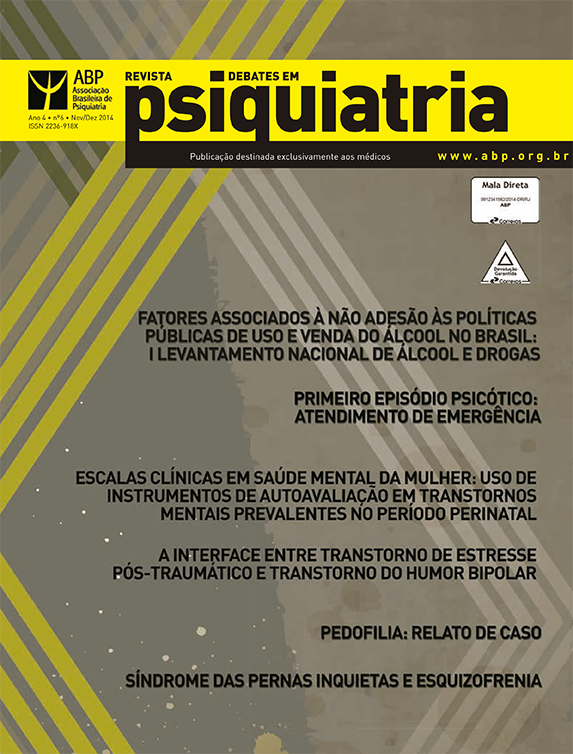
Escalas clínicas em saúde mental da mulher: uso de instrumentos de autoavaliação em transtornos mentais prevalentes no período perinatal
DOI:
https://doi.org/10.25118/2763-9037.2014.v4.184Palavras-chave:
Perinatal, depressão pós-parto, escalas de autoavaliaçãoResumo
O uso de escalas na prática clínica é bastante conhecido e pode ser útil quando os instrumentos são utilizados como parte do processo de avaliação diagnóstica, na identificação da presença ou ausência de um determinado transtorno, no monitoramento do progresso terapêutico e na quantificação e documentação da gravidade de determinados sintomas. O período perinatal pode estar associado a desfechos adversos e impactar de maneira negativa a saúde mental das mulheres. Embora existam poucos instrumentos especificamente desenvolvidos para essa subpopulação, há uma uma crescente tendência em se afirmar que o monitoramento cuidadoso e contínuo de sintomas e condições psiquiátricas prevalentes nesse período através de questionários de autoavaliação pode trazer benefícios na tomada de decisão ou busca de acompanhamento especializado e precoce, quando necessário.
Downloads
Métricas
Referências
American Psychiatric Association. DSM-5. Am J Psychiatry. 2013. http://ajp.psychiatryonline.org/article.aspx?articleID=158714nhttp://scholar.google.com/scholar?hl=en&btnG=Search&q=intitle:DSM-5
Greene JG. A factor analytic study of climacteric symptoms. J Psychosom Res. 1976;20:425-30.
Greene JG. Constructing a standard climacteric scale. Maturitas. 1998;29:25-31.
Kessler RC, McGonagle KA, Zhao S, Nelson CB, Hughes M, Eshleman S, et al. Lifetime and 12-monthprevalence of DSM-III-R psychiatric disorders in the United States. Results from the National Comorbidity Survey. Arch Gen Psychiatry. 1994;51:8-19.
Kessler RC, Keller MB, Wittchen HU. The epidemiology of generalized anxiety disorder. Psychiatr Clin North Am. 2001;24:19-39.
Kessler RC, Chiu WT, Demler O, Merikangas KR, Walters EE. Prevalence, severity, and comorbidity of 12-month DSM-IV disorders in the National Comorbidity Survey Replication. Arch Gen Psychiatry. 2005;62:617-27.
Wenzel A, Haugen EN, Jackson LC, Brendle JR. Anxiety symptoms and disorders at eight weeks postpartum. J Anxiety Disord. 2005;19:295-311.
Wenzel A, Haugen EN, Jackson LC, Robinson K. Prevalence of generalized anxiety at eight weeks postpartum. Arch Womens Ment Health. 2003;6:43-9.
Ruscio AM, Stein DJ, Chiu WT, Kessler RC. The epidemiology of obsessive-compulsive disorder in the National Comorbidity Survey Replication. Mol Psychiatry. 2010;15:53-63.
Zambaldi CF, Cantilino A, Montenegro AC, Paes JA, de Albuquerque TLC, Sougey EB. Postpartum obsessive-compulsive disorder: prevalence and clinical characteristics. Compr Psychiatry. 2009;50:503-9.
Viguera AC, Tondo L, Koukopoulos AE, Reginaldi D, Lepri B, Baldessarini RJ. Episodes of mood disorders in 2,252 pregnancies and postpartum periods. Am J Psychiatry. 2011;168:1179-85.
Munk-Olsen T, Laursen TM, Meltzer-Brody S, Mortensen PB, Jones I. Psychiatric disorders with postpartum onset: possible early manifestations of bipolar affective disorders. Arch Gen Psychiatry. 2012;69:428-34.
Sharma V, Burt VK, Ritchie HL. Bipolar II postpartum depression: Detection, diagnosis, and treatment. Am J Psychiatry. 2009;166:1217-21.
Kim J-H, Choi SS, Ha K. A closer look at depression in mothers who kill their children: is it unipolar or bipolar depression? J Clin Psychiatry. 2008;69:1625-31.
Cox JL, Holden JM, Sagovsky R. Detection of postnatal depression. Development of the 10-item Edinburgh Postnatal Depression Scale. Br J Psychiatry. 1987;150:782-6.
Matthey S, Fisher J, Rowe H. Using the Edinburghpostnatal depression scale to screen for anxiety disorders: Conceptual and methodological considerations. J Affect Disord. 2013;146:224-30.
Matthey S. Using the Edinburgh Postnatal Depression Scale to screen for anxiety disorders. Depress Anxiety. 2008;25:926-31.
Beck CT, Gable RK. Postpartum depression screening scale: Development and psychometric testing. Nurs Res. 2000;49:272-82.
Cantilino A, Carvalho JA, Maia A, Albuquerque C, Cantilino G, Sougey EB. Translation, validation and cultural aspects of postpartum depression screening scale in Brazilian Portuguese. Transcult Psychiatry. 2007;44:672-84.
Hirschfeld RM, Williams JB, Spitzer RL, Calabrese JR, Flynn L, Keck PE Jr, et al. Development and validation of a screening instrument for bipolar spectrum disorder: the Mood Disorder Questionnaire. Am J Psychiatry. 2000;157:1873-5.
De Sousa Gurgel W, Rebouças DB, Negreiros de Matos KJ, Carneiro AH, Gomes de Matos e Souza F, Grupo de Estudos em Transtornos Afetivos Affective Disorders Study Group. Brazilian Portuguese validation of Mood Disorder Questionnaire. Compr Psychiatry. 2012;53:308-12.
Castelo MS, Carvalho ER, Gerhard ES, Costa CM, Ferreira ED, Carvalho AF. Validity of the mood disorder questionnaire in a Brazilian psychiatric population. Rev Bras Psiquiatr. 2010;32:424-8.
Frey BN, Simpson W, Wright L, Steiner M. Sensitivity and specifi city of the Mood Disorder Questionnaire as a screening tool for bipolar disorder during pregnancy and the postpartum period. J Clinical Psychiatry. 2012;73:1456-61.
Spitzer RL, Kroenke K, Williams JB, Löwe B. A brief measure for assessing generalized anxiety disorder: the GAD-7. Arch Intern Med. 2006;166:1092-7.
Simpson W, Glazer M, Michalski N, Steiner M, Frey BN. Comparative effi cacy of the generalized anxiety disorder 7-item scale and the Edinburgh Postnatal Depression Scale as screening tools for generalized anxiety disorder in pregnancy and the postpartum period. Can J Psychiatry. 2014;59:434-40.
Lord C, Rieder A, Hall GB, Soares CN, Steiner M. Piloting the perinatal obsessive-compulsive scale (POCS): development and validation. J Anxiety Disord. 2011;25:1079-84.
Downloads
Publicado
Como Citar
Edição
Seção
Licença

Este trabalho está licenciado sob uma licença Creative Commons Attribution-NonCommercial 4.0 International License.
Debates em Psiquiatria permite que o (s) autor (es) mantenha(m) seus direitos autorais sem restrições. Atribuição-NãoComercial 4.0 Internacional (CC BY-NC 4.0) - Debates em Psiquiatria é regida pela licença CC-BY-NC